

Know First.
The only platform tracking the friction between what Australian households pay and what they can sustain. 10 million households. Primary sources only. Updated weekly. No surveys. No noise. Just the data.
AHI Score: Historical Trend
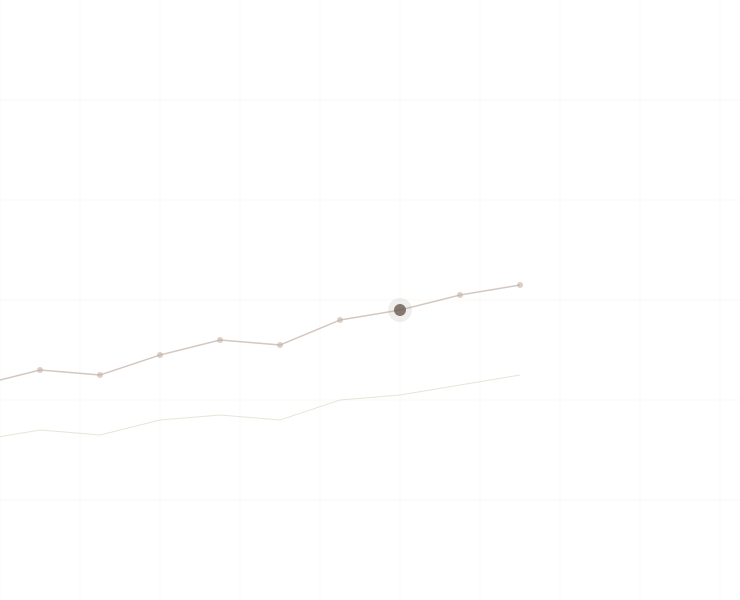
Weekly composite since June 2025The AHI is a weekly time series, not a single snapshot, and the path it has traced matters as much as the latest reading. It launched in June 2025 with the cash rate at the peak of its tightening cycle, eased as the Reserve Bank cut rates from August, then climbed again through 2026 as three consecutive hikes returned the rate to where it began and the Hormuz fuel shock pushed energy costs higher. Across the whole period it has not left the Elevated band, and it remains there now.
Weekly composite score from AHI launch (June 2025) to the last week shown, drawn from primary ABS and RBA data.
Cost of Living Breakdown
Eight categories tracked weeklyAHI Behaviour Index
What households are doing — not just what things costRetail spending patterns reveal how households are responding to cost pressure. When essential spending rises while discretionary falls, households are compressing — the clearest real-world signal of financial stress. Source: ABS Retail Trade (8501.0), seasonally adjusted.
Source: ABS Retail Trade 8501.0. Seasonally adjusted, current prices. Monthly data.
CBA HSI and NAB Consumer Sentiment data are published monthly and updated manually. Next update due: May 2026 (CBA HSI Apr release + NAB Apr survey). Source links: CBA Economics · NAB Research
Three complementary layers: ABS transaction volumes (what was spent), Google Trends distress signals (what households are searching for), and CBA/NAB sentiment data (how households feel). Together they paint a more complete behavioural picture than any single source.
AHI Score API →Wages vs Costs
Are households keeping pace?Cost of living data without income context is only half the picture. This overlay tracks the real purchasing power gap between what wages have grown and what costs have grown since 2019. Source: ABS Wage Price Index (6345.0) and ABS CPI (6401.0).
In real terms, Australian wages have lost purchasing power since 2019, and the gap is larger in housing, energy and insurance than in the headline CPI basket.
Source: ABS Wage Price Index 6345.0 (quarterly, June 2019 base), ABS CPI 6401.0, Fair Work Commission. WPI measures wage rates excluding bonuses; it measures the price of labour, not average earnings. Real wage figures updated quarterly following ABS release. See RBA scenario engine →
The AHI Explained
Methodology — effective April 2026What the AHI measures. The Australian Household Index is a weekly composite measure of household financial conditions in Australia. It publishes three headline measures: the AHI Score — overall household financial stress, combining cost pressure, formal financial outcomes, and leading indicators of future conditions; the Cost Pressure Index — what Australian households are paying for essential goods and services relative to 2019 pre-pandemic baselines; and the Stress Cycle Gap — the distance between cost pressure and composite financial stress. A positive gap means households are absorbing cost pressure without yet cascading into formal financial failure.
Data sources. Every signal in the AHI architecture is sourced from primary Australian government and regulatory data. The platform draws exclusively from: the Australian Bureau of Statistics (CPI, Housing Expenditure Survey, Wage Price Index, Lending Indicators, Retail Trade, National Accounts); the Reserve Bank of Australia (Financial Stability data, credit and charge card statistics, business conditions surveys, monetary policy data); the Australian Energy Regulator (Default Market Offer pricing, energy hardship data); the Australian Prudential Regulation Authority (mortgage arrears, banking system stress indicators); and the Australian Financial Security Authority (personal insolvency statistics). The AHI does not use commercial surveys, bank-sponsored research, or any data source with a commercial interest in the findings. No licensed data is used anywhere in the model.
Architecture. The AHI uses a three-tier architecture. Cost Pressure measures what households are paying across eight essential categories — housing, groceries, transport, fuel, insurance, health, energy, and telecommunications. Scores are calibrated against historical stress thresholds derived from Australian administrative data. Formal Outcomes measures what is actually happening to households financially, drawn entirely from regulatory administrative data. Formal outcomes reflect decisions households have already made or failures that have already occurred. Leading Indicators measures where conditions are heading. The platform’s leading indicator signals have been empirically validated against formal household stress outcomes using historical Australian and international data. The three tiers are combined into a composite score using a weighted arithmetic method with a continuous amplifier that ensures elevated cost pressure alone is insufficient to produce a high composite score without confirmation from formal outcomes or leading indicators.
Independence. The AHI is an independent publication. It accepts no advertising, no commercial partnerships, and no industry sponsorship. No commercial organisation influences the methodology or its outputs. The platform is founded and directed by Adjunct Associate Professor Graeme Hughes of Griffith University.
Methodology enquiries. Detailed methodology documentation is available to academic researchers, government agencies, and institutional partners under a research collaboration agreement. Media enquiries and methodology questions: media@australianhouseholdindex.com.au
About the Platform
The Australian Household Index was built to fill a specific gap: rigorous, independent economic intelligence about Australian household conditions, produced without commercial instruction.
Every figure is drawn from official government and major financial institution sources. No commercial organisation influences the methodology or its interpretation. The platform accepts no advertising or industry sponsorship.
It is founded and directed by Adjunct Associate Professor Graeme Hughes of Griffith University — whose independence from the sectors this platform monitors is not incidental to the work. It is the work.
Get the weekly AHI Pulse in your inbox
Each week, the AHI Pulse delivers the current score, the eight-category breakdown, and the plain-English interpretation — direct to your inbox. No advertising. No commercial content. Just the numbers.
Published weekly. Unsubscribe any time. No spam, ever.
Your Personal Cost of Living Score
How does your household compare to the national AHI?Enter your household's weekly spending across the main AHI categories to calculate your personal score and see where you sit relative to the national index. All figures stay in your browser — nothing is sent or stored.
Your personal score uses the same ABS-weighted methodology as the national AHI. National averages used as benchmarks are sourced from the AHI live category index. All data stays in your browser.